
OWN · MODELO 210
Declare Imputed Income
For those who own a property in Spain and use it privately or have it available for personal use during all or part of the year.
Read more →If you rent out your property in Spain, the rental income is taxed in Spain even if you reside in another country. Estity guides you through income, rental periods, and relevant expenses up to the completed declaration.

Estity is registered as a Social Collaborator with the Spanish tax authority, Agencia Tributaria (AEAT), and can submit declarations digitally for our clients.


How is rental income taxed in Spain?
As a non-resident, you are generally required to declare income from renting out a property located in Spain. Rental income is declared through Modelo 210 and is subject to the Spanish income tax for non-residents, IRNR.
How the tax is calculated depends, among other things, on your tax residency and which expenses can be considered. According to Agencia Tributaria's current guidance, the tax rate is 19% for individuals residing within the EU as well as Iceland, Norway, and Liechtenstein. For other taxpayers, the general tax rate is 24%.
For individuals covered by the EU/EEA rules, expenses that have a direct and economic connection to the rental income may be deductible when the conditions are met.
Good to know: If the property is only rented out for part of the year, the rental periods and periods for private use are treated separately. You may therefore need to declare both rental income and imputed income for the same property and year.
Enter the property, ownership share, and the basic information needed for the declaration.
Register rental periods and the rental income for the year.
Gather the costs and documentation that may affect the taxable result.
Check the declaration and submit Modelo 210 digitally.
MODEL 210
Gather your rental periods, rental income, and relevant expenses in Estity. We guide you through the tasks to a completed digital declaration.
Rental Income
Details of the rental income you received during the year.
Rental Periods
Total number of days the property was actually rented out.
Costs and Documentation
Receipts and documentation for expenses that may be relevant for the declaration.
Ownership Details
NIE, ownership share, and information about who owns the property.
Property Details
Property details, including referencia catastral and other information related to the property.

Do you want to get a first impression of the tax before you start declaring? Use our free rental income tax calculator.
For rental income from 2026 and later, which is grouped annually and where the declaration results in tax payable, the declaration period is April 1–20 the year after the income year. For 2026, this means April 1–20, 2027. For electronic payment through direct debit, the period is April 1–15.
For declarations of 2026 income submitted separately, special transitional rules apply. Income up to and including September 2026 follows the previous quarterly deadlines, while income from October 2026 is subject to the new April deadline.
Declarations submitted from January 1, 2027, include new information such as the number of rental days and ownership share, as well as an attachment for specifying deductible expenses. Estity shows which declaration period and information apply to the declaration you are working with.
MODEL 210
Let Estity guide you through rental periods, income, and relevant costs up to a completed Model 210 submitted digitally.
Yes. Income from renting out a property in Spain can be taxed in Spain even when the owner is tax-resident in another country.
The current guidance from the Tax Agency generally indicates 19% for residents within the EU as well as Iceland, Norway, and Liechtenstein, and 24% for other taxpayers.
For individuals covered by EU/EEA regulations, expenses with a direct economic connection to rental income may be deductible when the conditions are met. Which expenses can be used depends on the circumstances and documentation.
Yes. If a property is owned by several people, each co-owner is considered a separate taxpayer within IRNR.
This means, for example, that a couple who each own 50% should normally declare their respective shares through Modelo 210.
The tax is calculated based on each person's ownership share and tax residence. This is particularly important if the owners are tax residents in different countries, as the tax rate and the right to deduct costs may differ.
The Agencia Tributaria explicitly states that when a property is owned by several people, each owner must declare their proportional share.
In the new version of Modelo 210 used for declarations from 2027, there is a specific field for the number of days the property has been rented.
Yes. If the property has both been rented out and available for your own use, the periods are treated separately.
Yes. Estity guides you through the declaration process and can submit Modelo 210 digitally.
Do you use the property privately or plan to sell? Estity also assists you with other declarations related to your property ownership in Spain.
For those who own a property in Spain and use it privately or have it available for personal use during all or part of the year.
Read more →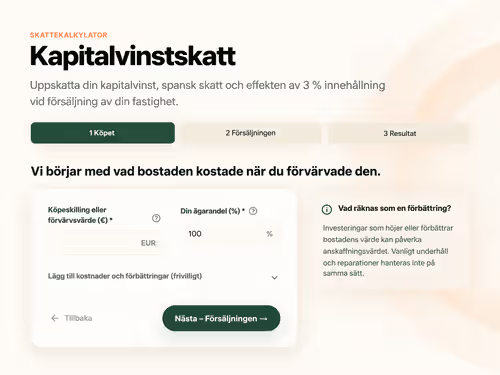
Calculate the capital gain, the Spanish tax, and how the 3% withholding affects the final result when you sell your property in Spain.
Read more →Get help with identification, documents, and digital access – practical services that simplify your home ownership in Spain.

Get your Spanish digital ID (certificado digital) through Estity. Secure digital ID for authority contact and document signings.
Read more →
Get your Spanish NIE (Número de Identificación de Extranjero) with the help of Estity. For non-residents who need an NIE for property, taxes, banking, and contracts.
Read more →
Request a Nota Simple for your Spanish property through Estity. Verify ownership, loans, and legal status. Fast digital delivery.
Read more →