
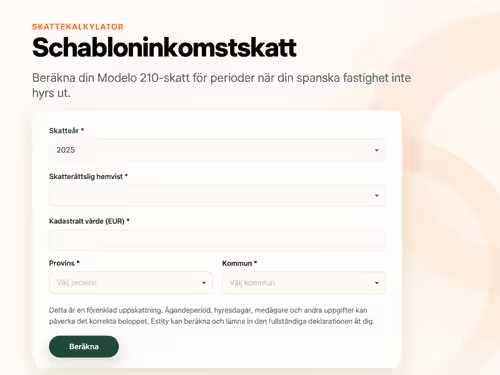
TAX CALCULATOR
Imputed Income Tax for Property in Spain
Get a quick estimate of the imputed income tax for your property in Spain.
Read more →
As a non-resident, you are taxed in Spain on income from renting out your Spanish property. Here you can estimate the tax and understand how rental income, expenses, and your tax residency affect the calculation.


As a non-resident, you are taxed in Spain for income from renting out a property located in Spain. The income is declared through Modelo 210 and is subject to the Spanish non-resident income tax, IRNR.
The starting point is the rental income you receive from the property. How the taxable income is calculated depends, among other things, on where you have your tax residence and which costs can be deducted.
For individuals with tax residence within the EU as well as Iceland, Norway, and Liechtenstein, the tax rate is 19%. For other taxpayers, the general tax rate is 24%.
If the property is only rented out for part of the year, the rental income is taxed for the rental periods. For the days the property is instead used privately or is at your own disposal, you may simultaneously be subject to the rules on imputed income.
Good to know: Rental income and imputed income are two different parts of the taxation. A property that is both rented out and used privately during the same year can therefore be subject to both.
How is the tax on rental income calculated?
The calculation starts with the rental income associated with the property.
For individuals who, according to AEAT's current guidance, are tax residents within the EU/EEA with applicable information exchange costs that have a direct connection to the rental income may be deductible in the calculation of the taxable result.
This can, for example, involve costs that are directly attributable to the rental. Depreciation may also be included under certain conditions, but costs should normally be attributed to the period when the property was actually rented.
The calculator provides a simplified estimate. Depreciation, number of rental days, ownership share, type of cost, and other individual circumstances can affect the final amount.
Which costs can be deductible?
For owners covered by the rules on cost deductions, financing costs, repair and maintenance, and depreciation may be relevant, provided the conditions are met and the costs can be linked to the rental.
When should rental income be declared?
This page needs to be a bit more pedagogical than the imputed income page because the rules change in 2026.
For rental income pertaining to 2025, the income, when the conditions for grouping are met, can be declared collectively for the year. Such an annual declaration would be submitted from January 1–20, 2026. For rental income from 2024 onwards, there is an option for annual grouping in Modelo 210.
For rental income pertaining to 2026, a new main deadline is introduced. For annual grouping, the declaration and payment must be made between April 1 and 20, 2027. Payment via bank domiciliation can be made from April 1–15.
During the transition in 2026, special rules apply for income declared separately. Rental income up to September 2026 follows the previous quarterly deadlines, while income from October 2026 is subject to the new April deadline.
New rules from 2026 - Rental income for 2026 declared annually must be submitted from April 1–20, 2027. Modelo 210 will simultaneously have new details, including the number of rental days, ownership share, and an appendix for deductible costs.
MODELO 210
Estity helps you calculate, prepare, and submit Modelo 210 for your rental income digitally.
Rental income from a property in Spain is normally taxable in Spain even if you live and are tax resident in another country.
As a non-resident, you usually declare the income through Modelo 210.
The starting point is the rental income you have received from the property. If you meet the rules for cost deductions, certain directly related costs can be deducted.
For income from 2026, a new cost basis will also be introduced in Modelo 210 where deductible costs must be specified in more detail.
Therefore, keep ongoing rental income, bookings, invoices, receipts, and information about rental days.
Applies to: 🇪🇸 National
Yes, as a non-resident property owner, rental income from a property in Spain is generally taxable in Spain.
The income is usually declared through Modelo 210.
Which deductions you can make, the applicable tax rate, and when the declaration should be submitted depend, among other things, on your tax residency and the income year the declaration pertains to.
See Tax & declaration for more information on the calculation and the new declaration periods.
Form 210 must be reported in euros, even if the tenant has paid in, for example, Swedish kronor, Norwegian kroner, or British pounds.
For transactions in another currency, the income or expense should normally be converted to euros using the official exchange rate published by the European Central Bank and communicated to the Bank of Spain for the day the income or expense occurred.
If no official rate was published that day, the last published rate before the date is normally used.
Therefore, it is good to save both the amount in the original currency, the date, and the euro amount that has been used.
Yes, if you are subject to the rules that allow for cost deductions when renting out, depreciation can be an important deductible expense.
For the building, depreciation is normally considered tax-acceptable up to 3% per year on the higher of the building's acquisition value or cadastral building value, excluding land value. The amount should be proportioned according to the rental period.
For installations, furniture, and furnishings rented out with the home, there is a simplified depreciation table where, for example, furniture and furnishings normally have a maximum depreciation rate of 10% per year.
Depreciation can also affect the calculation of a future capital gain upon sale.
Yes. If a property is owned by several people, each co-owner is considered a separate taxpayer within IRNR.
This means, for example, that a couple who each own 50% should normally declare their respective shares through Modelo 210.
The tax is calculated based on each person's ownership share and tax residence. This is particularly important if the owners are tax residents in different countries, as the tax rate and the right to deduct costs may differ.
The Agencia Tributaria explicitly states that when a property is owned by several people, each owner must declare their proportional share.
If you group the rental income for 2026 annually and the declaration results in tax to be paid, according to the new rules, it should be declared between April 1 and April 20, 2027. For payments via direct debit, the period is April 1–15.
There is a transitional rule during 2026. Those who have chosen to declare each rental income separately can still be subject to the old quarterly deadlines for income arising between April and September 2026. However, income from the last quarter of 2026 is subject to the new April deadline.
For most users who consolidate the year's rentals, April 1–20 the following year will thus be the central period going forward.
A Modelo 210 with zero quota, meaning zero tax to pay, has a different declaration period than a declaration with tax to pay.
It should normally be submitted between January 1 and 20 of the year following the year in which the income arose.
This means, for example, that a rental declaration for 2026 that results in zero tax after allowable deductions should normally be submitted January 1–20, 2027.
It is therefore important not to automatically use the April deadline for all rental declarations. April mainly applies to rental income declarations that result in tax to be paid according to the new rules.
Yes. You can proceed from the calculator and manage your Modelo 210 through Estity. Estity is registered as a Social Collaborator with the Spanish tax authority Agencia Tributaria (AEAT).
Get a better overview of the tax on your Spanish property – whether you use it privately or are considering selling.