
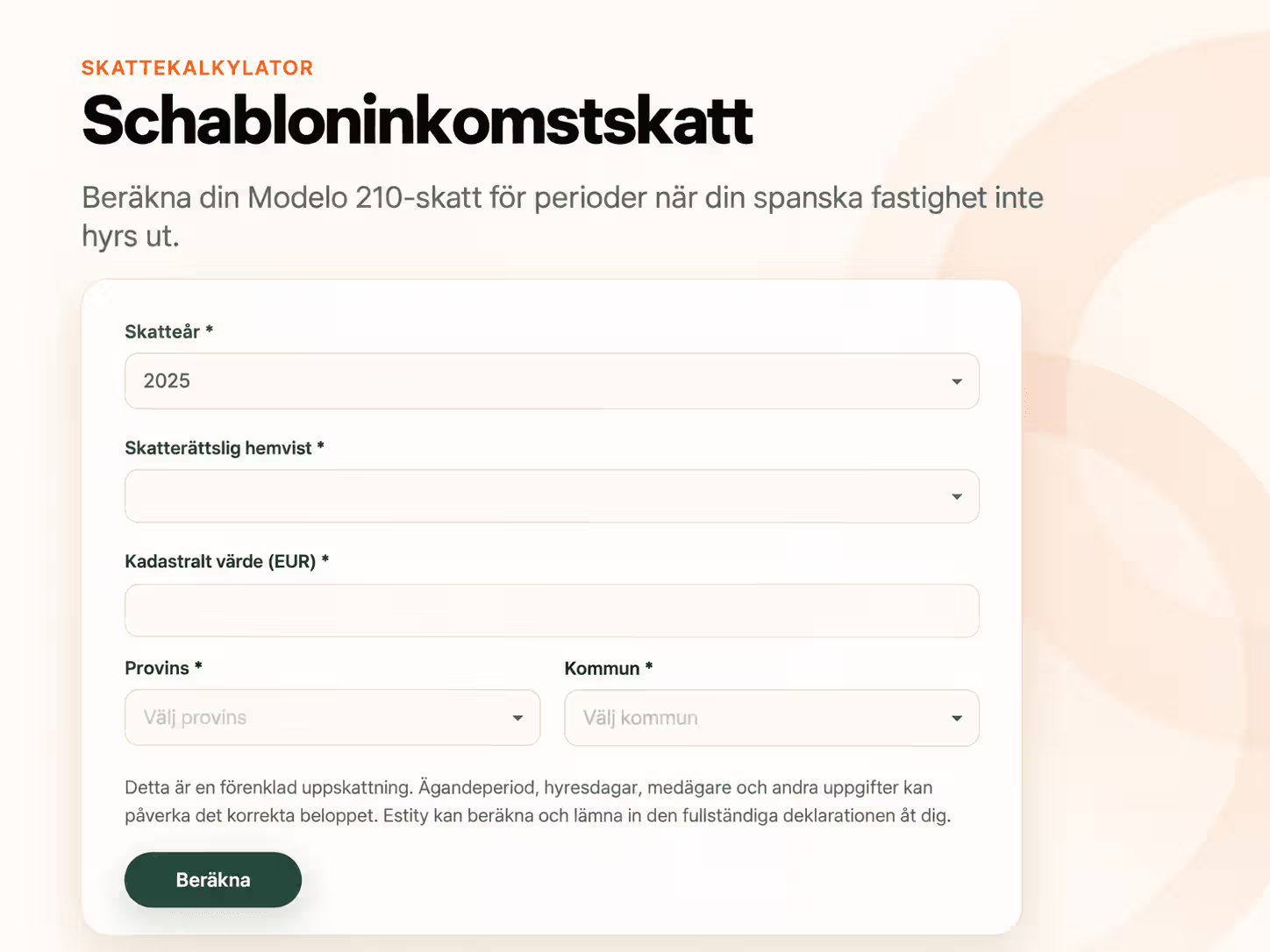
Imputed Income Tax for Property in Spain
As a non-resident property owner, you may need to declare Modelo 210 even when the property is not rented out. Here you can estimate the tax and understand what is behind the calculation.
Estity is registered as a Social Collaborator with the Spanish tax authority, Agencia Tributaria (AEAT).


WHAT APPLIES?
What is Imputed Income Tax in Spain?
As a non-resident individual who owns a property in Spain, you may need to pay tax even if the property is not rented out. In the Spanish tax system, private use or a property available to the owner is treated as an imputed property income, renta inmobiliaria imputada.
This does not mean that you have actually received any income. Instead, a tax base is calculated based on the property's valor catastral, the cadastral value normally found on your IBI notice. The tax is declared by non-resident owners through Modelo 210.
If the property has been rented out for part of the year, the imputed income is only calculated for the days the property was available to you. If the property has multiple owners, each owner's share is calculated based on their respective ownership share.
Good to know: Imputed income tax and tax on rental income are two different parts of Modelo 210. A property that is both used privately and rented out during the year can therefore be subject to both.
THE CALCULATION
How is the imputed income tax calculated?
The calculation is normally based on the property's valor catastral. A standard income is first calculated on this value with 1.1% or 2%, depending on when the municipality's cadastral values were last revised. The tax rate applicable to you is then applied to the calculated income. Agencia Tributaria
For individuals with tax residency within the EU and Iceland, Norway, and Liechtenstein, the tax rate is 19%. For other taxpayers, the general tax rate is 24%. No regular expenses for the property can be deducted from the imputed income. Agencia Tributaria
Valor catastral × 1.1% or 2% → imputed income × 19% or 24% → tax
If you only own a share of the property or it has been rented out during parts of the year, the calculation is adjusted according to your ownership share and the number of days the property was available to you.
Where can I find the valor catastral?
The valor catastral is found on your latest IBI notice. It is an administrative value determined by the Spanish property registry Catastro and should not be confused with the property's market value or purchase price.
MODELO 210
When should the imputed income tax be declared?
The imputed income is declared retroactively through Modelo 210 and refers to the calendar year the property was available to the owner.
For the income year 2025, the declaration period is January 1–December 31, 2026. The new deadlines introduced in 2026 do not change the declaration for 2025. Agencia Tributaria
For the income year 2026 and later, the declaration period opens instead on April 1 of the year following the tax year and runs until December 31. Imputed income for 2026 should therefore be declared between April 1 and December 31, 2027. For electronic payment via direct debit, the last day is normally December 23.
Do you want to go from calculation to declaration?
Estity helps you calculate, prepare, and submit your Modelo 210 digitally.
What is the difference between imputed and rental income tax?
Imputed income relates to periods of private use or availability for your own use. Rental income tax relates to income from letting the property. If you do both, you may need to consider both calculations for different periods.
Do I have to declare even if I haven't been in the residence during the year?
Yes, normally. It is not the number of days you actually spend in the residence that determines whether imputed income should be declared.
If the residence is at your disposal and not rented out, you as a non-resident private person may be subject to imputed rent. This applies even if you have not traveled to Spain at all during the year.
The calculation is normally based on the property's cadastral value and the part of the year the residence has been at your disposal. Therefore, there is a difference between the residence being empty and it being rented out – but an empty residence does not mean that the obligation to declare disappears.
Is valor catastral the same as the property's market value?
Applies to: 🇪🇸 National
No.
Valor catastral is an administrative value determined by Catastro based on factors such as land, building, and property characteristics.
It is not a market valuation of what the property could be sold for.
According to Catastro's rules, valor catastral as a general rule must not exceed the market value. It is used, among other things, in the calculation of IBI and certain other taxes. (catastro.hacienda.gob.es)
How do I declare if the property has been both rented out and used privately?
The year is divided based on how the property has been used.
For the days the property was rented out, the rental income is declared and, if you are entitled to it, relevant costs associated with the rental.
For the other days when the property was at your disposal, imputed rent is normally calculated.
This means, for example, that a property rented out for 100 days and available to the owner for 265 days receives two different tax treatments.
From declarations submitted in 2027, the number of rented and available days must be specified more clearly in Modelo 210.
What happens if multiple people own the property?
Each owner is taxed based on their share of ownership. For example, if two people each own 50%, the imputed income for each owner is calculated based on their own share of ownership.
Can Estity submit Modelo 210 for me?
Yes. You can proceed from the calculator and manage your Modelo 210 through Estity. Estity is registered as a Social Collaborator with the Spanish tax authority Agencia Tributaria (AEAT).