

Declare Imputed Income
For those who own a property in Spain that is used privately or not rented out part of the year. Estity helps you prepare and submit Modelo 210 digitally.Imputed Income
For those who own a property in Spain and use it privately or have it available for personal use throughout the whole or part of the year.
Declare through Estity
Estity is registered as a Social Collaborator with the Spanish tax authority, Agencia Tributaria (AEAT), and can submit declarations digitally for our clients.


WHAT APPLIES?
What is imputed income for a non-resident property owner?
As a non-resident owner of a property in Spain, you may need to declare tax even during periods when the property is not rented out. In the Spanish tax system, a property used privately or available to the owner is treated as an imputed real estate income, renta inmobiliaria imputada.
This does not mean that you have actually received any income. Instead, the tax is calculated based on the property's valor catastral (assessed value), the cadastral value that is normally found on your IBI notice.
The imputed income is declared through Modelo 210. If the property is owned by several people, each owner normally declares their share based on their ownership percentage.
Good to know: If the property has been rented out during parts of the year, the rental periods are treated separately. You may therefore need to declare both imputed income and rental income for the same property and year.
Declare Model 210 with Estity
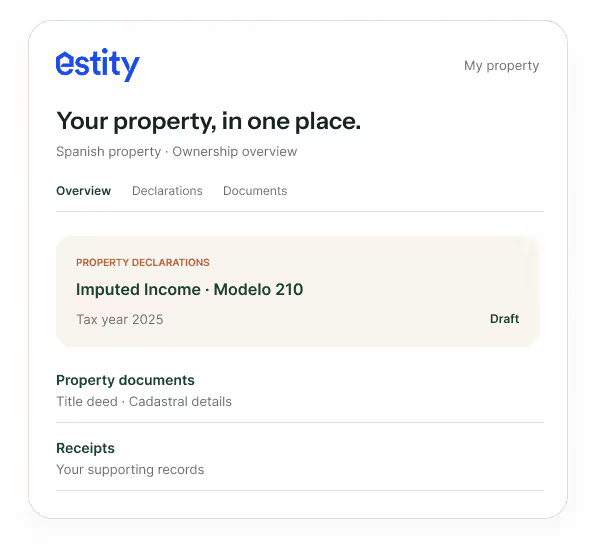
Add the property – Enter basic information about the property and ownership.
Complete the declaration information – Estity guides you through the information required for the imputed income.
Check the calculation – You see the basis and the calculated tax before the declaration is finalized.
Submit – The declaration is submitted digitally to Agencia Tributaria. The declaration receipt is uploaded to your portal in Estity or sent out via email.
Multiple owners – If the property has multiple owners, the declaration is made based on each owner's share and situation.
WHAT DO YOU NEED?
Have this at hand when you start.
IBI Notice
For, among other things, the cadastral value and property details.
NIE number
Your Spanish identification number.
Ownership share
How much of the property you own.
Usage during the year
Information about the ownership period and any rental.
DO YOU WANT TO CALCULATE FIRST?
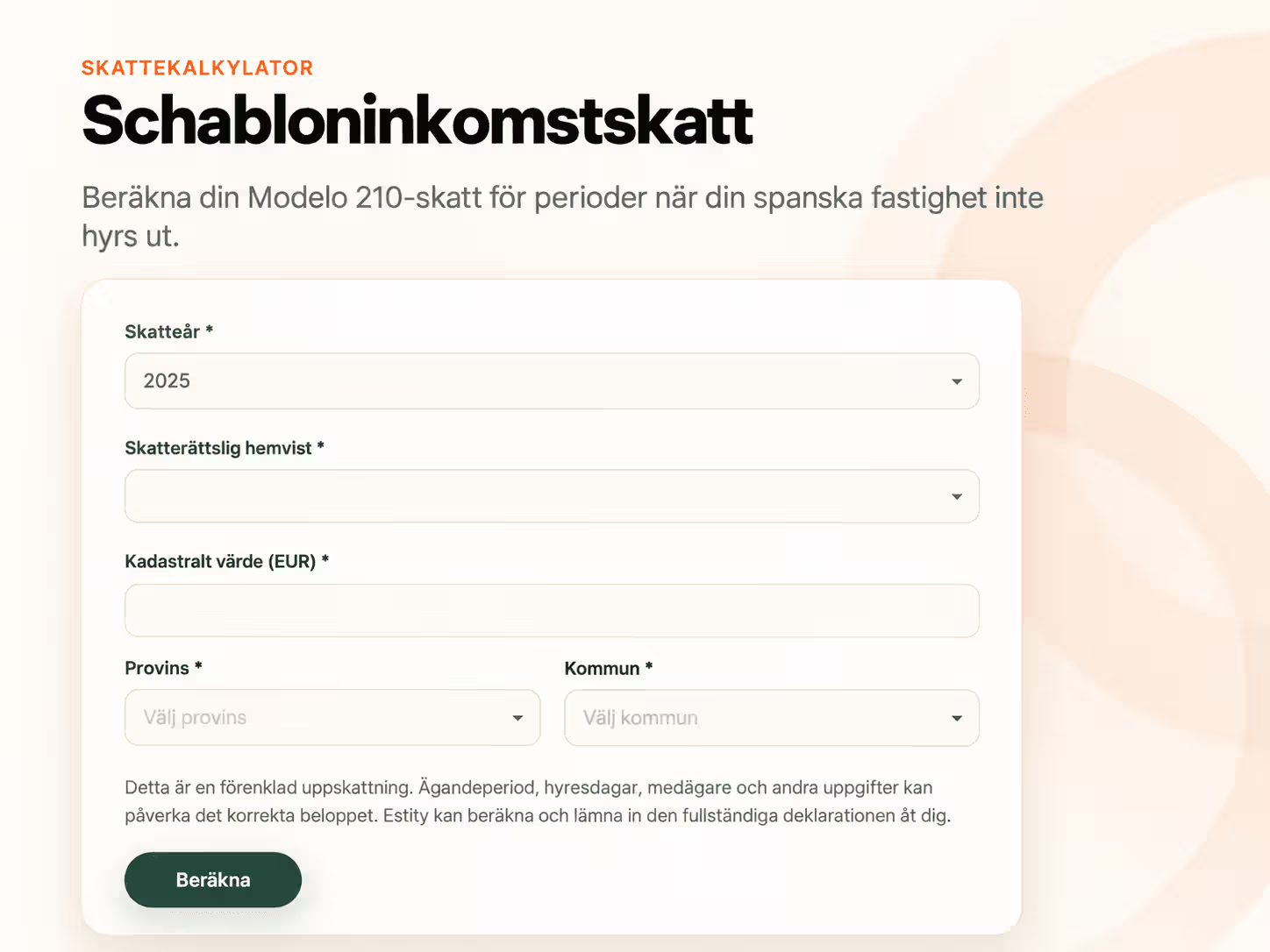
Estimate your standard income tax
Do you want to get an idea of the tax before you start the declaration? Use our free calculator to make a quick estimate.
WHEN SHOULD I DECLARE?
When should the imputed income be declared?
Imputed income is declared the year after the year to which the declaration pertains.
- Are you declaring for the income year 2025? → The declaration is submitted in 2026.
- Are you declaring for the income year 2026? → The new deadlines apply and the declaration is submitted in 2027.
Estity shows which period and deadline apply for the declaration you are working with.
Do I have to declare even if I haven't been in the residence during the year?
Yes, normally. It is not the number of days you actually spend in the residence that determines whether imputed income should be declared.
If the residence is at your disposal and not rented out, you as a non-resident private person may be subject to imputed rent. This applies even if you have not traveled to Spain at all during the year.
The calculation is normally based on the property's cadastral value and the part of the year the residence has been at your disposal. Therefore, there is a difference between the residence being empty and it being rented out – but an empty residence does not mean that the obligation to declare disappears.
Does each owner need to submit their own Modelo 210?
Normally, each non-resident owner declares their share based on their ownership percentage.
What do I need to file the declaration?
You need, among other things, information about the property, cadastral value, ownership share, NIE, and information about how the property has been used during the year.
What happens if I have rented out the residence for part of the year?
Rental periods and periods for private use are treated separately. You may therefore need to declare both rental income and standard income.
Where can I find the valor catastral to be used in the declaration?
Valor catastral is normally found on your IBI notice, your deed (Escritura), and in the information with the Spanish Catastro.
It is important to use the cadastral value and not the property's market value or purchase price. Valor catastral is an administrative value used, among other things, in the calculation of IBI and imputed income.
If the property lacks an established or notified valor catastral, there are special rules. For imputed rent, normally 50% of the highest of certain alternative values is used, such as the acquisition value or a value determined by the tax authority for other taxes.
Can Estity submit Modelo 210 for me?
Yes. You can proceed from the calculator and manage your Modelo 210 through Estity. Estity is registered as a Social Collaborator with the Spanish tax authority Agencia Tributaria (AEAT).
Can I first estimate approximately how much the tax will be?
Yes. Estity's free calculator gives you an estimate before you start the declaration.