
Spain Property Owner's Summary
The most important information for you as a homeowner in Spain. Market developments, changed tax regulations, and important dates. We summarize what is happening and what it means for you as a homeowner. October 26, 2026 Approximately 12 minutes reading time

In this edition
- Spanish housing market - Fewer foreign buyers – but still high prices
- Short-term rentals - 10% VAT – an important decision is approaching
- Modelo 210 changes - New declaration dates and clearer cost reporting
- Declare for 2025 - Important dates and practical advice
01 / HOUSING MARKET
Fewer foreign home buyers in Spain – but prices continue to rise
The Spanish housing market shows signs of change. In the first half of 2026, the number of home purchases by foreign buyers decreased by 13 percent compared to the same period the previous year. At the same time, housing prices continue to rise, and foreign buyers who are not residents in Spain still pay the highest prices.
The largest decline since 2020
According to a report from the Spanish notary organization, Consejo General del Notariado, published on _October 15, 2026_, foreign buyers made a total of 62,327 home purchases during the first six months of the year.
This represents a decrease of 13 percent compared to the first half of 2025 and is the largest percentage decline since the first half of 2020.
Foreign buyers accounted for 18.3 percent of all home purchases, compared to 19.2 percent during the same period in 2025 and 20.3 percent in 2024.
The decline was evident among foreign buyers who are not residents in Spain.

A market that has grown significantly over 15 years
To understand the recent decline, we need to put the numbers in a longer perspective.
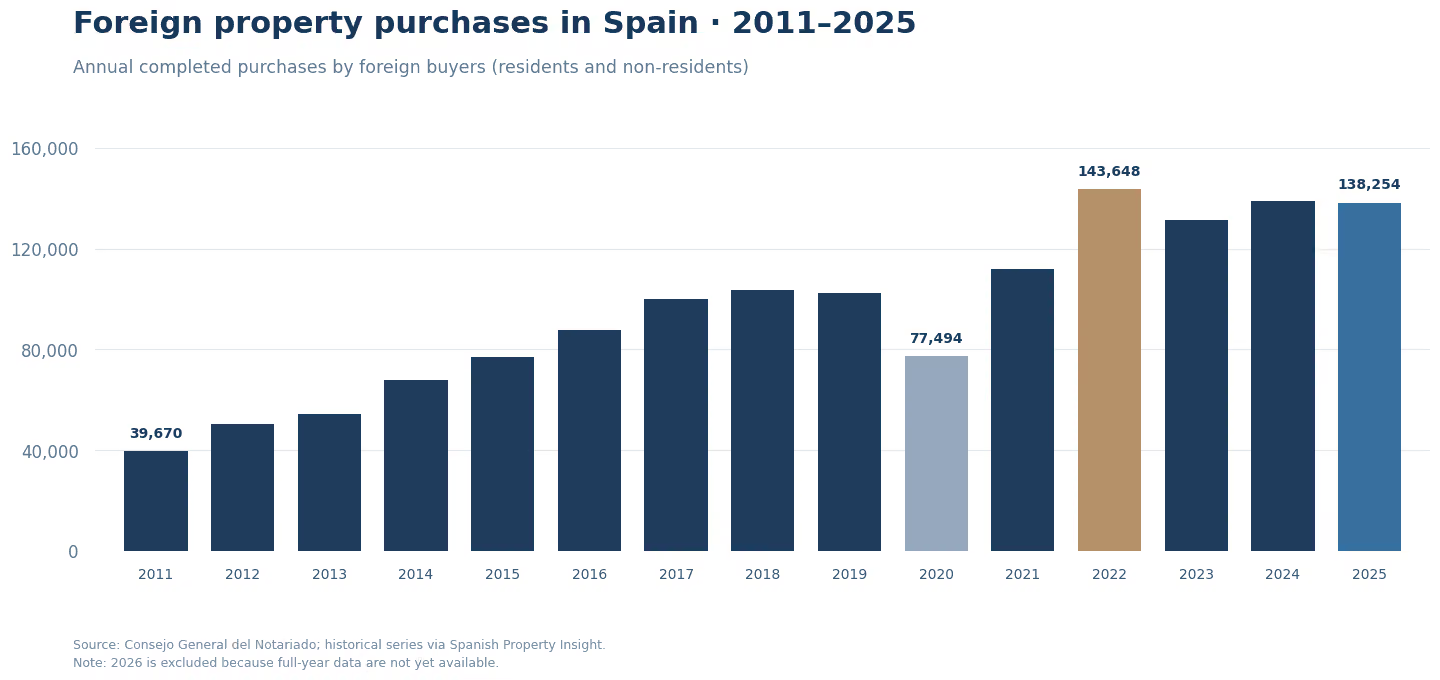
In 2011, foreign buyers made just under 40,000 home purchases in Spain. In 2022, a peak was reached with nearly 144,000 purchases, and in 2025, there were still just over 138,000 transactions.
This means that the number of foreign home purchases has more than tripled since 2011. However, the development has not been even. The pandemic in 2020 led to a clear decline, followed by a strong recovery in 2021 and 2022.
The fact that the number of purchases is now decreasing from historically high levels does not necessarily mean a trend reversal. It could also be a normalization after several years of strong demand.
Several factors can affect the development
The Spanish housing market is affected by both international and domestic conditions. Interest rates, exchange rates, and economic development in the buyers' home countries can affect the ability to purchase property abroad. At the same time, rising housing prices and a limited supply in attractive areas have made it more expensive to enter the market.
An interesting question is also whether a generational shift might begin to affect demand. Many foreign property owners have had their properties in Spain for several decades. As life situations change, some may choose to sell and return to their home countries, while high prices may make it more difficult for the next generation to buy.
However, there is insufficient statistics to determine the significance of such a generational shift for the current development.
What does the development mean for us who already own property in Spain?
For existing property owners, it is primarily the local market that is of interest. National averages provide an overall picture but do not necessarily indicate how the value of an individual property develops.
Fewer completed purchases do not necessarily mean falling housing prices. In the first half of 2026, average prices continued to rise, while the number of transactions decreased.
For those planning to sell, the development may mean that it becomes more important to follow demand, competition, and sales times in their own area.
Overall, the statistics show a housing market still characterized by high prices and significant international interest, but where buying activity has begun to change. Whether it is a temporary normalization or the beginning of a changed behavior remains to be seen.
02 / RENTAL & REGULATIONS
Short-term rentals in Spain – 10% VAT and an important decision approaching
Spain has published new regulations that may mean that short-term rentals of homes will be subject to 10 percent VAT from December 1, 2026. The change could affect both the rental economy and administrative handling. At the same time, VAT liability could also mean the possibility of deducting VAT on costs related to the rental. But first, a crucial step in the parliamentary process awaits.
What do the new rules mean?
On October 7, 2026, Real Decreto-ley 29/2026 was published in Spain's official gazette, Boletín Oficial del Estado (BOE).
The decree contains several measures affecting the housing market, including changes in VAT handling for short-term rentals.
According to Article 7, the rental of furnished homes is normally subject to 10 percent VAT when the rental period to the same tenant does not exceed 30 nights. Some exceptions exist, including rentals in the landlord's own permanent residence.
Today, regular home rentals without hotel-like services are exempt from VAT. If the provisions continue to apply, it would mean a change for many private homeowners renting to vacationers.
Which homeowners could be affected?
The rules affect not only professional landlords or larger property companies. Even private individuals renting out a vacation home for shorter periods may be affected. The crucial factors include rental length, use of the home, and whether the conditions in the legislation are met. For us who use the home privately part of the year and rent it out during other periods, the change may therefore be relevant.

How can VAT liability affect the rental economy?
A potential VAT liability not only means that 10 percent VAT must be charged on the affected rental income. It may also mean the right to deduct input VAT on costs attributable to the VAT-liable activity. The economic effect is therefore distributed over several factors.
If the market accepts a higher total price, the VAT can largely be passed on to the guest. If the price, however, needs to remain unchanged, the landlord's income excluding VAT is affected. At the same time, the right to deduct input VAT can partially compensate for this effect.
The right to deduct becomes an important part of the calculation
For homeowners subject to VAT liability, the ability to deduct input VAT can become economically significant. This can include costs for cleaning, repairs, maintenance, brokerage services, and operations, provided the costs meet the requirements for deduction. This is particularly interesting for homes with extensive rentals or larger investments in maintenance and furnishings.
The right to deduct is not general, however. For homes used both privately and for rental, costs need to be assessed based on their connection to the VAT-liable activity. Some costs may be directly attributable to the rental, while others pertain to both private use and rental.
VAT and Modelo 210 – parallel reporting obligations
If the new VAT rules are introduced, short-term rentals may be subject to both VAT reporting and existing income taxation through Modelo 210. VAT is normally reported quarterly through Modelo 303, while rental income from 2026 according to the new rules can be summed annually in Modelo 210 and declared in April the following year.
This means that the same economic transactions can form the basis for two separate declarations, but with different rules for periodization and deductions. Input VAT can be deductible in VAT reporting, while cost deductions in Modelo 210 are assessed according to income tax rules. For homeowners combining private use with rental, it is therefore particularly important to have ongoing accounting where rental income, costs, and VAT can be distinguished and tracked over time.
A potential VAT liability thus not only means a change in taxation but also increased demands on financial administration.
November 5 – an important date
Real Decreto-ley 29/2026 came into force on October 8, 2026, but since it is a Spanish decree-law (real decreto-ley), it must be processed by the congress within 30 days from issuance. November 5, 2026 is the last day within this constitutional deadline. For the decree to continue to apply, explicit approval is required. If it is rejected or not approved within the prescribed time, its continued validity ceases.
The new VAT provision has a separate application date: December 1, 2026.
At the publication of this article on October 27, 2026, a final parliamentary decision has not yet been confirmed. It is therefore too early to assume that the new VAT rules will definitely come into effect.
Estity is prepared and we are following the parliamentary process to adapt the platform when the rules change. It should be just as easy even if reporting requirements change.
03 / TAX & DECLARATION
Changes in Modelo 210 in 2027 – new declaration dates and clearer cost reporting
Spain has decided on changes to Modelo 210 that affect non-resident homeowners from 2027. The new rules involve changed declaration periods and more detailed requirements for reporting rental income and deductible costs.
New dates for declaration
For us renting out homes in Spain, the change means that annually summed rental income with tax payable must be declared between April 1 and 20, instead of in January the year after the rental.
The declaration of imputed income (renta imputada) is also affected. From 2027, the declaration period opens on April 1 instead of January 1, while the last declaration day remains December 31.
The new deadlines apply from the income year 2026. For rental declarations with zero results, special rules apply, with declaration in January.
Clearer reporting of costs and ownership shares
Another important change is that deductible costs for rental must be specified in a new annex to Modelo 210, instead of just being reported as a total amount.
The declaration also receives clearer information about the number of days the property was rented or available for private use and each owner's share of the property.
The changes do not in themselves change tax rates or extend deduction rights, but place higher demands on ensuring that income, costs, and associated documentation are correctly documented.
What does it mean for you as a homeowner?
For those renting out, it becomes increasingly important to continuously register rental income and costs, save invoices, and have a clear division between private use and rental.
The new rules are already decided, and Estity is adapting the declaration service to the changes for 2027.

04 / IMPORTANT DATES
Have you declared your property in Spain for 2025?
The year is coming to an end, and with it the last date for this year's Modelo 210 declaration. As a non-resident property owner, you normally need to declare imputed income (renta imputada) for the time the property was available for private use, even if you had no rental income.
Two dates to keep an eye on:
- December 28, 2026 – last day for payment via direct debit.
- December 31, 2026 – last day to submit the declaration for 2025.
Haven't declared yet?
No worries, there is still time. With Estity, you can make your Modelo 210 declaration digitally, at your convenience, and regardless of where you are.
The declaration costs €79 per owner and through Estity you also get a consolidated place for the property's finances, documents, and important dates.