TAX CALCULATOR
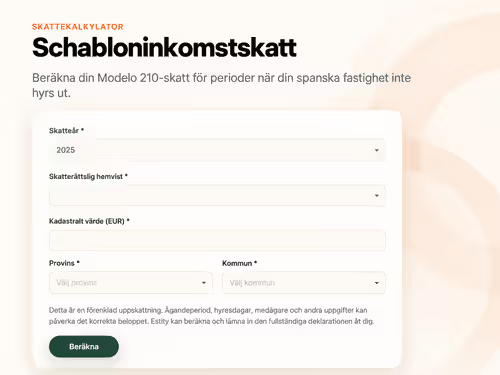
Imputed Income for Property in Spain
Get a quick estimate of the imputed income tax for your property in Spain.
Read more →Do you own, rent out, or have you sold a property in Spain? As a non-resident, you may need to declare through Model 210. With Estity, you get help calculating the tax and submitting your declaration digitally.

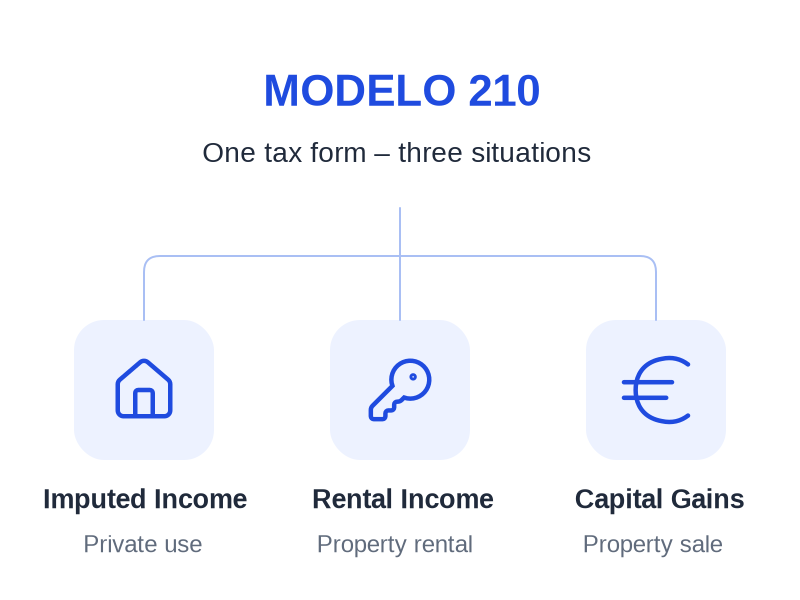
Modelo 210 is used by individuals who are not tax residents in Spain to declare certain income and capital gains that are taxed there.
For those who own a property, it usually involves imputed income, rental income, or capital gain from a sale.
Which declaration you need depends on how the property has been used and what has happened during the year.
For those who use the property privately or have it available for personal use.
From tax calculation to submitted declaration with AEAT.
For those who use the property privately or have it available for personal use.

For those who rent out their property in Spain. Gather rental income and relevant expenses to easily declare the rental through Modelo 210.

Have you sold your property in Spain? Estity helps you understand what information is needed and how the capital gain should be declared through Modelo 210.

Choose a calculator that suits you and get an idea of your tax on your Spanish property.
Get a quick estimate of the imputed income tax for your property in Spain.
Read more →
Calculate Spanish tax on rental income from your property and get an overview of how income and deductible expenses affect the tax.
Read more →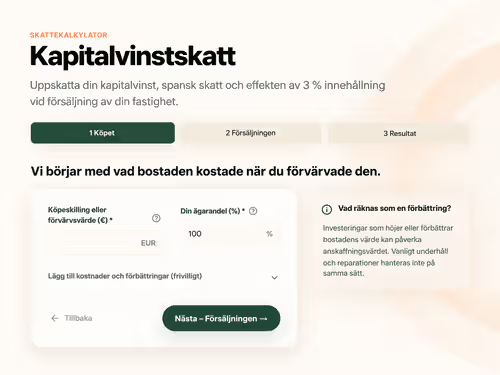
Calculate the capital gain, the Spanish tax, and how the 3% withholding affects the final result when you sell your property in Spain.
Read more →Renting out the property for part of the year does not automatically eliminate the obligation to declare imputed income. Different periods and events may need to be reported separately. Additionally, if there are multiple owners, the declaration needs to be handled based on each person's situation and ownership share.
Imputed income 2025 – By December 31, 2026
Imputed income 2026 – April 1–December 31, 2027
Rental income 2026, annually grouped with tax payable – April 1–20, 2027
Capital gain on sale – Three months after the first month from the sale
From your data to a submitted declaration. Estity guides you through the process and handles the submission to the Spanish tax authority.
Choose your declaration
Choose imputed income, rental income, or capital gain based on your situation.
Fill in your details
Enter information about yourself, the property, and the details needed for the declaration. Estity guides you through the process.
Review and pay
See your tax calculation, verify the details, and complete the payment for the declaration service. Any tax is paid according to the payment option you choose.
We submit and report back
Estity handles the submission to AEAT and reports back when the declaration is registered. The documentation is available in your account.


Modelo 210 is the official Spanish tax form used by individuals who are not tax residents in Spain but own property there. The form is used to declare and pay taxes on income from Spanish property, such as:
Yes, normally. It is not the number of days you actually spend in the residence that determines whether imputed income should be declared.
If the residence is at your disposal and not rented out, you as a non-resident private person may be subject to imputed rent. This applies even if you have not traveled to Spain at all during the year.
The calculation is normally based on the property's cadastral value and the part of the year the residence has been at your disposal. Therefore, there is a difference between the residence being empty and it being rented out – but an empty residence does not mean that the obligation to declare disappears.
Applies to: 🇪🇸 National
Yes, as a non-resident property owner, rental income from a property in Spain is generally taxable in Spain.
The income is usually declared through Modelo 210.
Which deductions you can make, the applicable tax rate, and when the declaration should be submitted depend, among other things, on your tax residency and the income year the declaration pertains to.
See Tax & declaration for more information on the calculation and the new declaration periods.
For the income year 2025, the previous declaration period applies. Modelo 210 for imputed income can be filed between January 1 and December 31, 2026.
For the income year 2026, the new rules apply. The declaration must be filed between April 1 and December 31, 2027.
This means that the declaration period is moved forward by three months starting with the declaration of the 2026 imputed income.
When paying by direct debit, an earlier end date applies. For the 2026 imputed income, payment according to the new rules is valid until December 23, 2027.
If you group the rental income for 2026 annually and the declaration results in tax to be paid, according to the new rules, it should be declared between April 1 and April 20, 2027. For payments via direct debit, the period is April 1–15.
There is a transitional rule during 2026. Those who have chosen to declare each rental income separately can still be subject to the old quarterly deadlines for income arising between April and September 2026. However, income from the last quarter of 2026 is subject to the new April deadline.
For most users who consolidate the year's rentals, April 1–20 the following year will thus be the central period going forward.
Yes. If a property is owned by several people, each co-owner is considered a separate taxpayer within IRNR.
This means, for example, that a couple who each own 50% should normally declare their respective shares through Modelo 210.
The tax is calculated based on each person's ownership share and tax residence. This is particularly important if the owners are tax residents in different countries, as the tax rate and the right to deduct costs may differ.
The Agencia Tributaria explicitly states that when a property is owned by several people, each owner must declare their proportional share.
Spain's taxation of property owners is based on the principle that income and gains from properties can be taxed in the country where the property is located.
This applies to both actual rental income and gains from sales. For properties used privately, there is also a special imputed taxation, where a calculated income forms the basis for the tax.
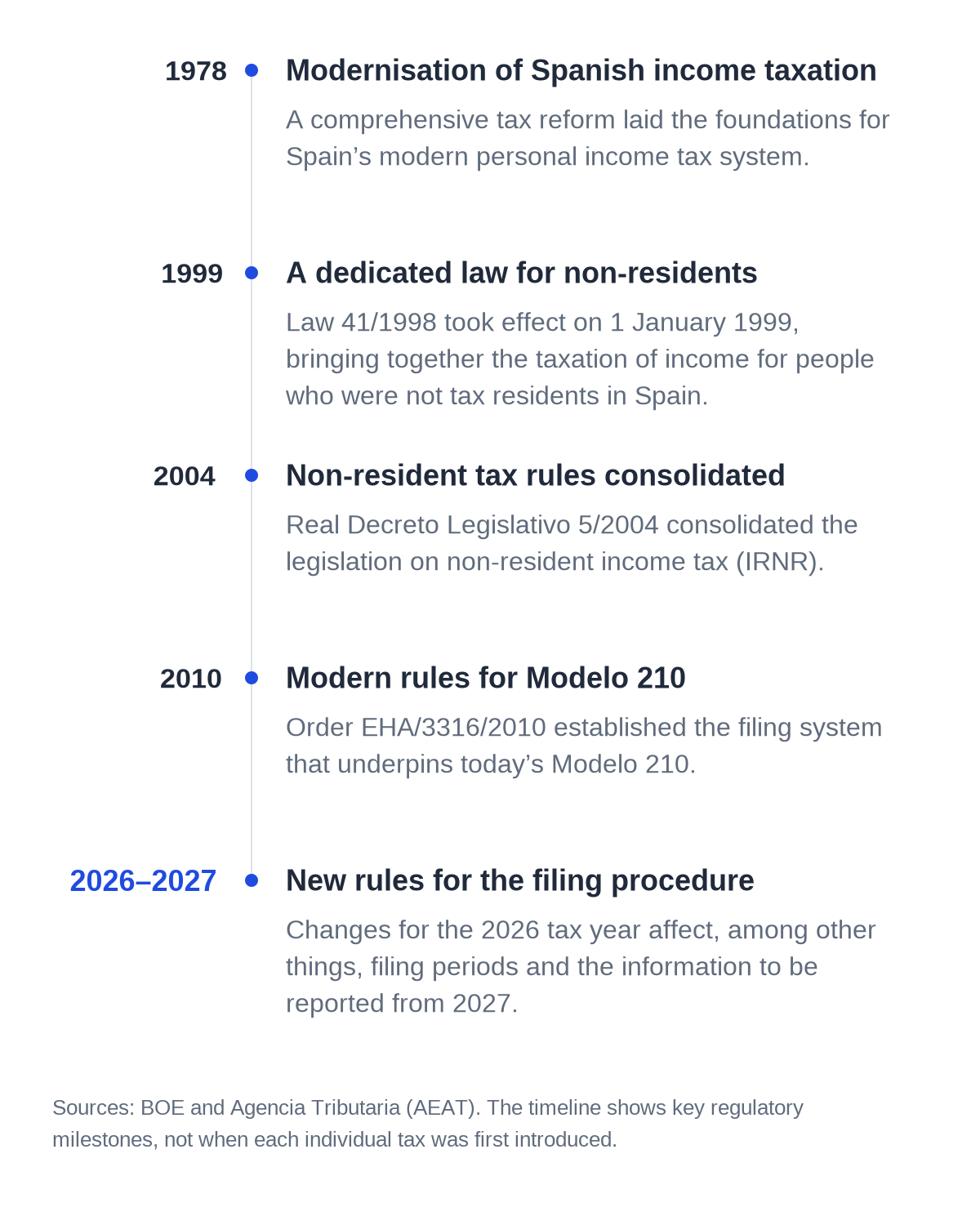
The rules have developed over several decades. Since 1999, there has been a consolidated legislation for the taxation of non-residents, and Modelo 210 is used today to report these incomes and gains.