
Modelo 210 is changing – new deadlines and clearer reporting of expenses
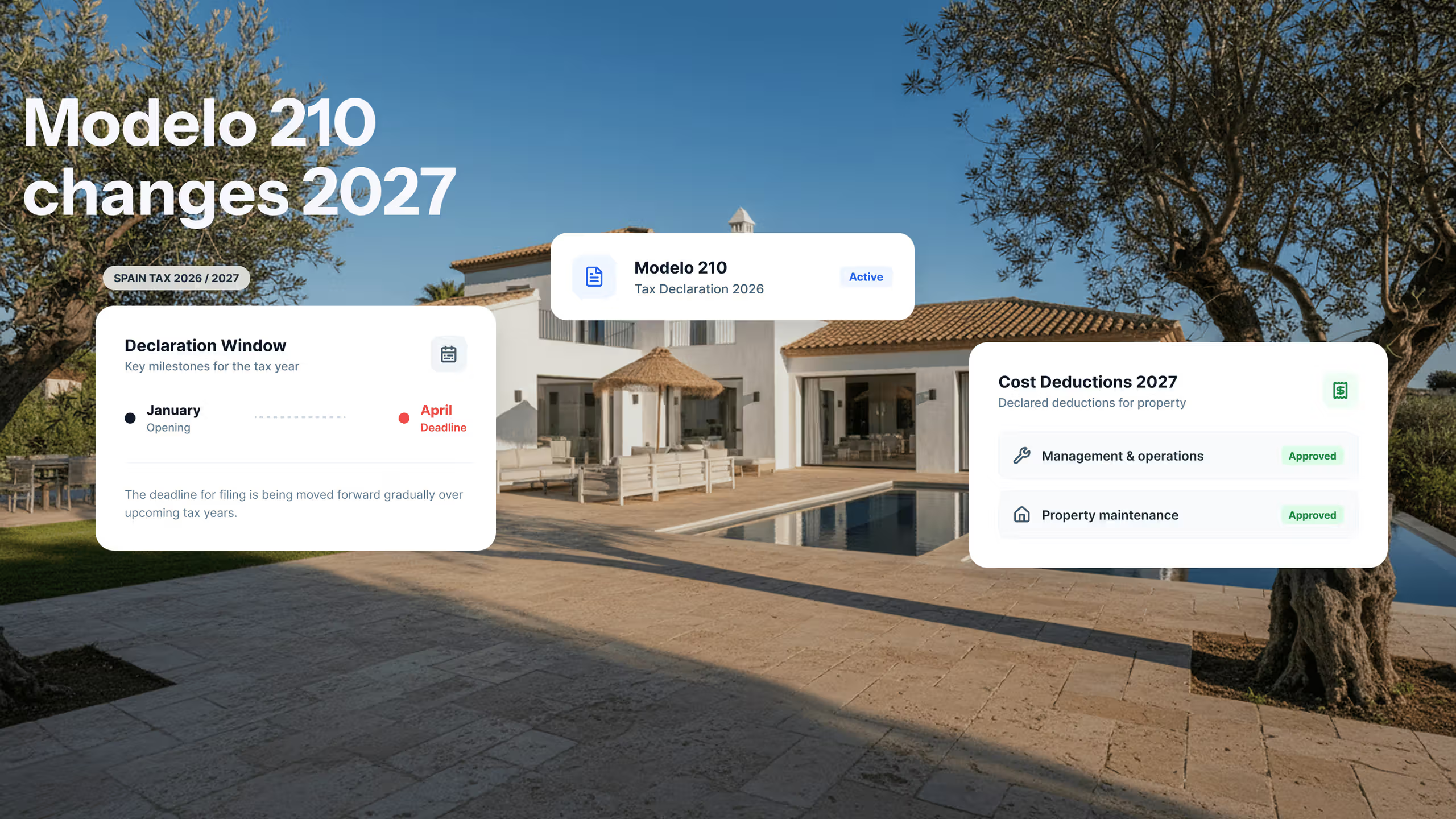
Spain is introducing new rules for Modelo 210, the tax return used by, among others, people who are tax resident outside Spain and own or rent out a property in the country.
The current filing dates will continue to apply to the 2025 tax year, with returns submitted in 2026. The new dates will apply from the 2026 tax year, with returns submitted in 2027.
The main change is that rental income resulting in tax payable must be declared in April instead of January. The filing period for owner-occupied properties will also begin later. At the same time, a new appendix will be introduced, requiring deductible expenses to be itemised and reported by expense category.
The tax rates and the basis for calculating the tax will remain unchanged. What will change are the filing dates and the information that must be provided.
New filing dates for rental income
Since the 2024 tax year, it has been possible to combine a full year’s rental income into a single annual Modelo 210 return. Until now, annually aggregated rental income has been declared in January of the year following the year in which the income was received.
For the 2025 tax year, with returns submitted in 2026, the current rules apply:
Filing and payment: 1–20 January 2026
Payment by direct debit: 1–15 January 2026
For the 2026 tax year, with returns submitted in 2027, the new rules apply:
Filing and payment: 1–20 April 2027
Payment by direct debit: 1–15 April 2027
The filing period for annually aggregated rental income will therefore move three months later—from January to April.

The change gives property owners more time to compile the year’s rental income, expenses and supporting documentation before submitting the tax return.
What does it mean to aggregate rental income?
Aggregating income means combining multiple rental payments from the same property during the calendar year into a single annual Modelo 210 return.
For example, if the property was rented out on several occasions during 2026, the income can normally be included in one return covering the entire year, instead of declaring each rental period separately.
It is important to distinguish between two separate aspects:
- Aggregation of income: This means combining the year’s rental income into a single annual tax return.
- Breakdown of expenses: This means sorting and reporting deductible expenses under specific expense categories.
The new Modelo 210 therefore requires a more detailed breakdown of expenses, even when the income is reported collectively for the entire year.
Expenses must be reported by expense category
In the previous version of Modelo 210, deductible expenses were primarily reported as a single total amount.
For tax returns submitted from 1 January 2027 onwards, a separate appendix will be introduced in which expenses must be broken down according to their purpose. It will therefore no longer be sufficient to report only the year’s total deductible expenses.
Expenses must be divided into categories including the following:
- Interest on capital used to purchase or improve the property.
- Repairs and maintenance.
- Community and homeowners’ association fees.
- Costs associated with drawing up rental agreements.
- Legal expenses.
- Payments to third parties for services provided.
- Electricity, water, internet, gas and other running costs.
- Insurance premiums.
- Taxes, surcharges and fees.
- Doubtful rental debts.
- Depreciation of furniture, fixtures and fittings.
- Depreciation of the building.
- Depreciation of improvements to the property.
Each expense must therefore be assigned to the correct category. The amounts are then added together to determine the total deductible expenses reported in the tax return.
The new requirement does not mean that more expenses will automatically become deductible. Each expense must still meet the applicable tax requirements and be directly related to the rental activity.
Example of how expenses should be categorised
During 2026, a property owner incurred the following rental-related expenses:
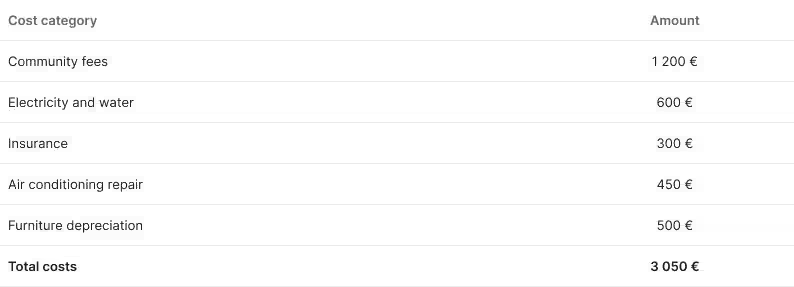
Previously, these expenses could be reported as a total deductible amount of €3,050. In the new appendix, the same total amount must be allocated across the different expense categories.
The tax calculation will still be based on the total deductible expenses, but the Spanish Tax Agency will receive more detailed information about what those expenses consist of.
Supporting documentation becomes more important.
The new breakdown means that property owners need to keep track of what each expense relates to.
Invoices and receipts should contain sufficient information to link the expense to the correct property, period and expense category. If the property is used both privately and rented out, certain expenses may also need to be apportioned based on the proportion of the year during which the property was rented out.
The fact that an expense was paid during the year does not automatically mean that the full amount is deductible.
The right to deduct expenses may be affected by factors including:
- What the expense relates to.
- How the expense is connected to the rental activity.
- How long the property has been rented out.
- The owner’s share of the property.
- The country in which the owner is tax resident.
When does a tax return show a zero balance?
A rental income tax return shows a zero balance when the tax calculation does not result in any tax being payable.
For a property owner who is entitled to deduct expenses under the applicable rules, this may occur when the deductible expenses are equal to or exceed the rental income.
If the rental income for the year amounts to €5,000 and the deductible expenses that can be claimed in the tax return amount to €5,000 or more, there will normally be no tax to pay.
However, this does not mean that the tax return can be omitted. A Modelo 210 showing a zero balance must still be submitted.
For the 2025 tax year:
- A zero-balance return must be filed between 1 and 20 January 2026.
For the 2026 tax year:
- A zero-balance return must be filed between 1 and 20 January 2027.
- Rental income resulting in tax payable must be declared between 1 and 20 April 2027.
The applicable filing period cannot therefore be determined solely by whether the property has been rented out. The result of the tax calculation must also be taken into account.
The calculation must be completed in good time to determine whether the tax return should be filed in January or April.
New information required on the number of days and ownership share.
The updated Modelo 210 also includes new fields for:
- The number of days the property was rented out.
- The number of days the property was available for personal use.
- The owner’s percentage ownership share.
- Whether the property has a Spanish referencia catastral.
A referencia catastral is the property’s unique identification number in Spain’s cadastral register, the Catastro. The number can usually be found on the IBI bill and normally consists of 20 characters.
If the property has multiple owners, each owner must normally declare their share of the income and expenses. The new field for ownership share makes this allocation clearer in the tax return.
New filing dates for personal use
Anyone who does not rent out their property, or uses it personally for part of the year, must normally declare imputed income for those days. This is known as renta imputada.
For the 2025 tax year, with returns submitted in 2026, the current rules apply:
- Filing and payment: 1 January–31 December 2026
- Payment by direct debit: 1 January–23 December 2026
For the 2026 tax year, with returns submitted in 2027, the new rules apply:
- Filing and payment: 1 April–31 December 2027
- Payment by direct debit: 1 April–23 December 2027

The final filing deadline remains 31 December. The change means that the tax return for the 2026 tax year cannot be submitted in January, February or March 2027.
Transitional rules for income declared separately
Anyone who declares rental income separately instead of aggregating the entire year is subject to special transitional rules during 2026.
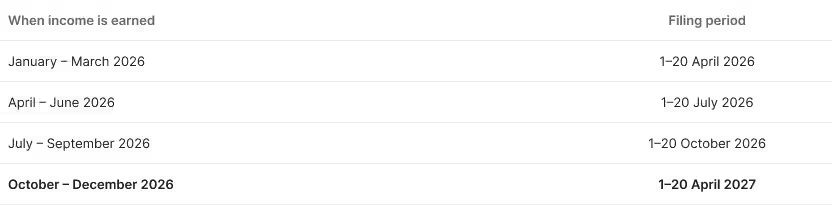
For annually aggregated rental income, the new April filing period applies to the entire 2026 tax year.
Summary of the changes
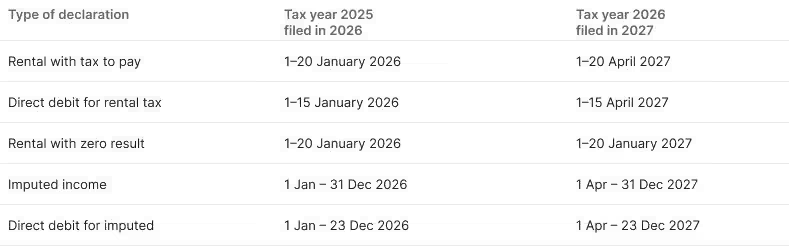
In summary, rental income tax returns resulting in tax payable will move from January to April, while zero-balance returns must still be filed in January. The tax return for personal use will retain the same final deadline as before but cannot be filed before 1 April.
At the same time, the reporting of deductible expenses will become more detailed. Expenses must no longer be reported solely as a total amount but must be broken down according to what they relate to.
File your tax return under the new rules with Estity.
When the new rules take effect, Modelo 210 tax returns prepared and submitted through Estity will follow the new filing periods and expense-reporting requirements.
For the 2026 tax year, with returns submitted in 2027, this means that the correct filing period will be applied depending on whether the return results in tax payable or a zero balance. Deductible expenses will also be reported under the categories required by the new form.
This will allow you to file your tax return in accordance with the new rules directly through Estity once the changes take effect.
Sources:
Order HAC/623/2026 in Spain’s Official State Gazette
Information from the Spanish Tax Agency on the new filing periods