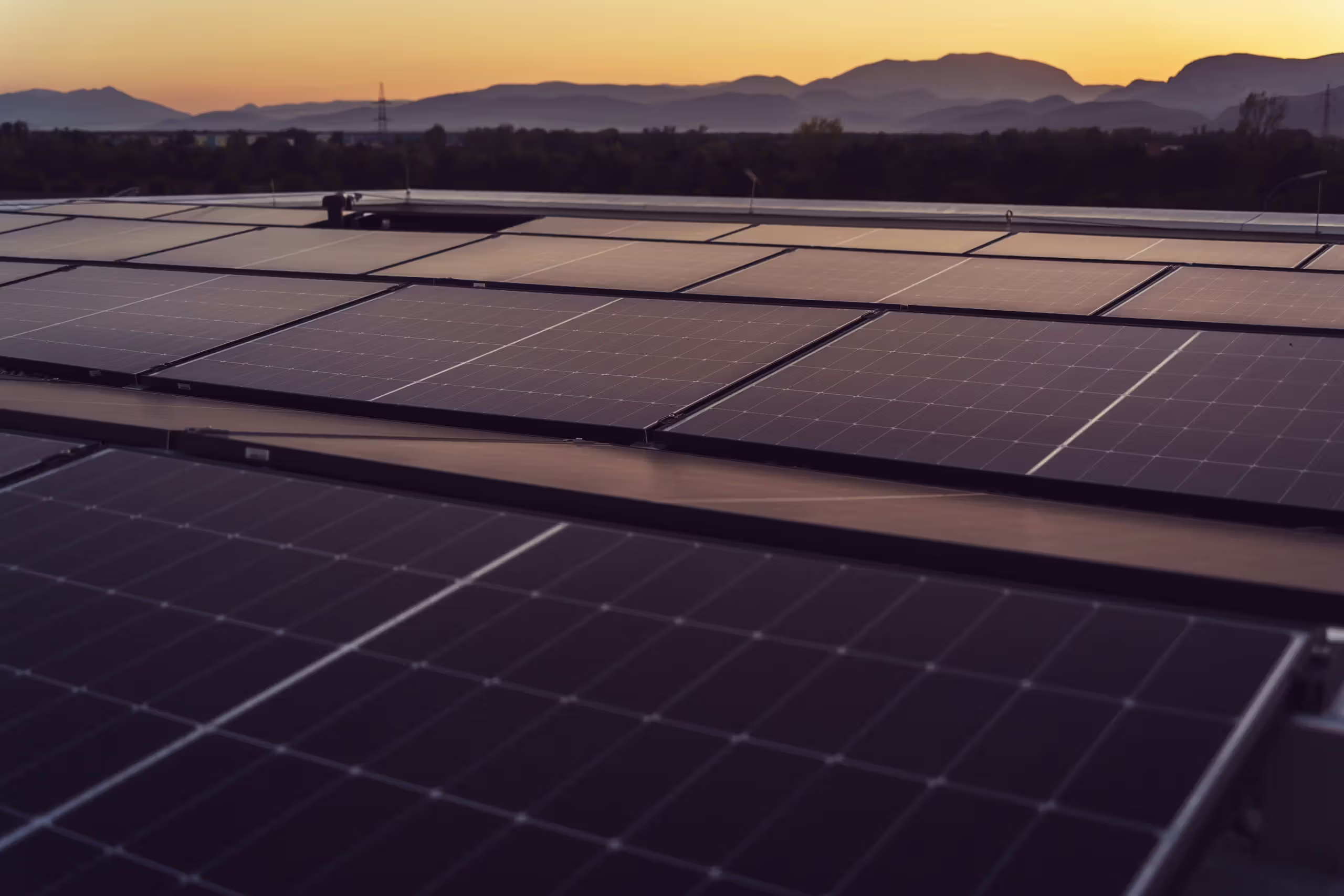
Solar panels in Spain – The sun make homeownership both cheaper and smarter.
In collaboration with Solar Panel Experts
For many who own a holiday or permanent home in Spain, the sun is an obvious part of quality of life. Bright days, a pleasant climate, and more months outdoors each year are often a big part of why the home was purchased in the first place.
But more and more people are also asking another question:
Can the sun actually contribute to lower living costs – and at the same time make the home more attractive and sustainable over time?
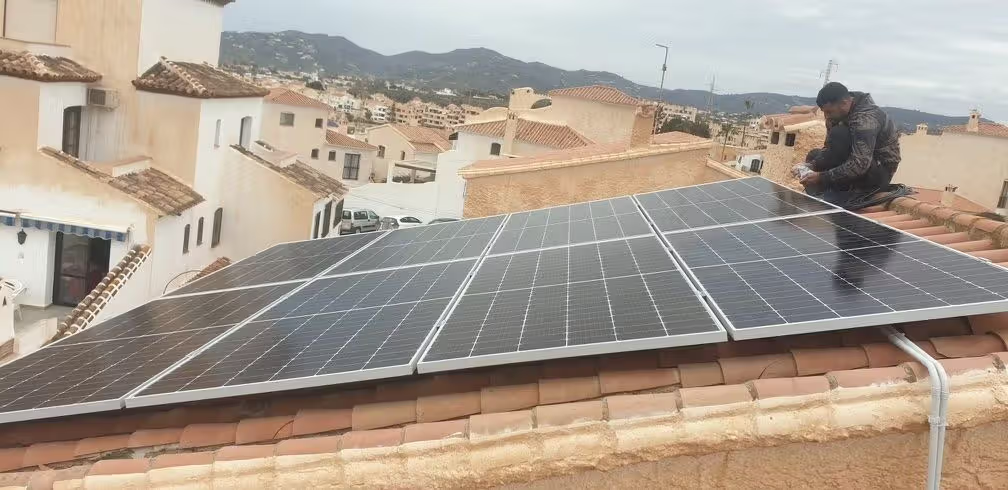
As energy prices rise, focus on sustainability increases, and better technical solutions become available, solar panels have become an increasingly common feature on Spanish rooftops. What was once perceived as both expensive and complicated has become significantly more accessible – and for many homeowners today, it's about much more than just the environment.
It's about controlling costs, long-term value, and more energy-efficient ownership.
5 Quick facts about solar panels in Spain
Over 300 sunny days per year
In many parts of southern Spain, especially along the Costa del Sol, there are some of the best conditions in Europe for solar power.
9 GW installed capacity
Spain now has over 9 gigawatts of installed solar capacity for self-consumption – and the market continues to grow rapidly.
36,000+ new installations in 2025
More and more households are choosing to invest in their own solar power, both to reduce costs and future-proof their homes.
Payback time of about 4–5 years
Thanks to many hours of sunshine and high electricity prices, the investment can often pay off faster than many think.
Can be combined with support from the home country
In some European countries, there are grants or tax benefits linked to investments in renewable energy – even if the home is in Spain.
From "Sun Tax" to growing interest
It may sound surprising, but Spain has not always been an obvious country for individuals to install solar panels.
Despite having some of the best conditions in Europe for solar power, development was long hindered by administrative obstacles and the infamous "sun tax", which made self-produced electricity less attractive.
It wasn't until 2018 that the fee was abolished, and the following year a new regulatory framework was introduced, making it significantly easier for individuals to install solar panels and produce their own electricity.
Since then, development has been rapid.
According to the Spanish industry organization UNEF, Spain now has over 9 GW of installed solar capacity for self-consumption, and just in 2025, more than 36,000 households installed new solar panel systems. This clearly shows that more and more homeowners see solar power as a long-term investment – especially in southern Spain, where the number of sunshine hours is among the highest in Europe.
There are several driving forces behind the development, but for many, it's fundamentally about the same thing:
gaining better control over ongoing costs and making the home more future-proof.
How long before the investment pays off?
One of the most common questions among homeowners is naturally:
When does the investment actually start to pay off?
The answer varies depending on the home's conditions, roof area, electricity usage, and the size of the installation. But thanks to the favorable climate in southern Spain, the payback time is often shorter than many think.
Along the Costa del Sol, where some areas have up to 320 sunny days per year, the payback time for many installations is estimated to be around 4–5 years. For some homes, it may take longer, especially depending on energy consumption and the scope of the investment – but over time, the difference in operating costs can be significant.
During the sunniest months of the year, electricity usage can in some cases be largely covered by self-produced electricity – especially in homes with pools, air conditioning, or high daily consumption.
Even on cloudy days, solar panels continue to produce electricity, albeit at lower levels. In some cases, production can still reach about 50 percent of capacity in cloudy weather, meaning production doesn't completely stop when the weather varies.
For many, it's therefore not just about lower electricity costs here and now – but about creating more predictable living costs over time.
Are there grants or tax benefits?
Something many people don't know is that the possibility of financial support is not always linked to where the home is located, but sometimes to which country you are tax-resident in.
Many European countries today offer various forms of support for investments in renewable energy, such as tax reductions, VAT relief, or direct grants for the installation of solar panels and battery storage. However, the rules differ between countries and change over time.
Therefore, it may be wise to investigate what opportunities exist in your own home country before making an investment.
One example is Sweden, where taxpayers can in some cases receive the so-called Green Technology Deduction, which today can provide:
- 15% tax reduction for the installation of solar panels
- 50% tax reduction for the installation of battery storage
The conditions vary depending on the country of residence, tax situation, and applicable national rules. Therefore, it is always recommended to check what opportunities apply in your own country before making a decision.
From skeptical to surprised – Our own experience
When we at Estity installed solar panels on our home in Spain, there were mainly two things that surprised us:
that the installation cost was more reasonable than expected – and that the payback time turned out to be shorter than we initially thought.
A few years later, we clearly see the effect in practice.
Today, electricity costs are about 60 percent lower compared to before, while we have gained significantly better control over energy consumption in the home.
The next step for us is battery storage, which could further reduce dependence on purchased electricity and allow an even larger part of the energy needs to be covered by the electricity produced on our own roof.
This is, of course, an individual example, and the outcome varies depending on the home, usage, and installation. But it also shows why more and more people are starting to see solar power as more than just an environmental issue.
For many, it ultimately comes down to something quite simple: making homeownership more predictable, cost-effective, and stable
A more sustainable homeownership
Even though the economy often sparks the initial interest, the sustainability aspect is becoming increasingly important. By producing your own renewable energy, the home's climate impact can be reduced while dependence on traditional energy sources becomes lower.
It's not necessarily about becoming completely self-sufficient in electricity – but about reducing the energy demand from the grid and using the natural conditions that already exist. As energy requirements and sustainability issues gain greater importance in Europe, energy-efficient homes are becoming increasingly relevant.
Can solar panels affect the home's value?
There are no guarantees for exactly how much an installation affects the home's market value. But much suggests that energy-efficient homes become more attractive to future buyers.
Lower operating costs, better energy performance, and modern energy solutions can make a home more interesting on the market – especially in areas where energy consumption is high for large parts of the year.
For many, the investment is therefore not just about economics today, but also about enhancing the home's attractiveness for the future.
What actually applies in Spain?
Today, it's much easier to install solar panels than before, but certain practical and legal aspects still need to be handled.
Depending on the home's location and type, it may involve:
- Local regulations and any permits
- Conditions in urbanization or community
- Registration and legalization of the installation
- The possibility of receiving compensation for surplus electricity sent back to the grid
Additionally, some Spanish municipalities offer tax relief or reduced municipal property tax (IBI) for a period after the installation of solar panels, which can further improve the investment calculation. Therefore, it may be wise to start by understanding the specific conditions of your own home before making a decision.
A first step can be easier than you think
- Understand if solar panels are right for your home.
- What are the roof's conditions?
- How much electricity is actually used?
- Which solution provides the best effect over time?
Here, the right advice can make a big difference.
Solar Panel Experts help homeowners on the Costa del Sol analyze conditions, plan installation, and manage the process – from the first analysis to the finished solution.
At Estity, we build collaborations with actors and specialists in areas that often become important in homeownership. By highlighting services, solutions, and opportunities, we aim to provide homeowners with better knowledge, increased control, and easier paths to the right help.